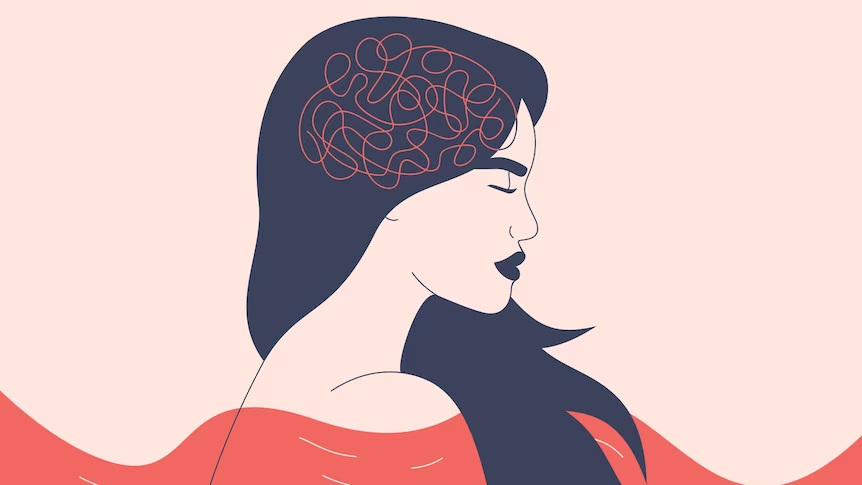
She whispered five words that changed everything: “I feel like I’m disappearing.”
The 44-year-old mother sat across from us, hands folded tightly in her lap. Her eyes were rimmed red from bone-deep exhaustion, not tears. She’d been to five doctors in two years. All of them said the same thing: “Your labs look normal.”
But nothing felt normal.
She woke at 3 a.m. with her heart pounding, drenched in sweat, mind racing. Her hair fell out in clumps. Her joints ached like she was 80. Despite barely eating and forcing herself through HIIT classes, she’d gained 25 pounds around her belly.
Her periods swung between crime scene intensity one month and nothing the next. Worst of all, her brain felt broken. She forgot appointments, snapped at her husband for breathing too loud, then hated herself for it.
Every provider told her: “Everything looks fine.”
The Problem With Normal
We see this story every week in our practice. Women carrying a full-body cry for help, walking out with antidepressants and zero answers.
The conventional system treats women like small men with complex emotions. Most medical research still bases itself on male physiology, leaving women with outdated solutions regardless of what their bodies actually communicate.
“Normal” doesn’t mean optimal. It means falling within wide, outdated reference ranges designed to detect disease, not dysfunction.
That cultural script has been playing for decades. Tired, anxious, gaining weight, not sleeping? Probably just stress. Or aging. Or you’re overreacting.
This dismissal teaches women not to trust their own instincts. We built our practice to be the opposite of that.
The Hormonal Symphony Approach
We tell our patients: your hormones are like a symphony. When balanced, everything feels harmonious. You sleep well, your mood stays steady, your weight remains stable, your brain stays clear.
But when just one section plays off-key, the whole piece feels chaotic. That’s what most women live with: a hormonal symphony completely out of tune, with no one listening closely enough to hear it.
We run what we call “real labs.” Comprehensive, functional panels that go far beyond what most primary care providers check. We assess over 55 markers because everything from mood to metabolism gets orchestrated by delicate system interactions.
Full thyroid panels, not just TSH. Cortisol rhythm mapping throughout the day. Sex hormones: estradiol, progesterone, testosterone, DHEA. We check the ratios, not just individual numbers.
We assess insulin and fasting glucose because wild blood sugar swings sabotage everything from sleep to weight to mood. We look at inflammatory markers like CRP because underlying inflammation can mute the entire symphony.
Nutrients matter more than most people realize. We check vitamin D, B12, ferritin, magnesium, zinc, even Omega-3 levels. You can’t run a biochemical orchestra without raw materials.
Strategic Healing Sequence
When everything feels off, the temptation is fixing it all at once. True healing comes from choosing the right starting point. The one that creates the biggest ripple effect through her whole body.
We always start by listening to her story first, not just her labs. The body doesn’t lie, but neither does lived experience.
If she’s waking at 3 a.m. wired, heart racing in traffic, running on fumes and caffeine, her nervous system is screaming. We start by calming cortisol. Until her body feels safe, nothing else shifts sustainably.
If her PMS is unbearable, cycles erratic, crying at the drop of a hat, we begin with progesterone support. That one hormone does heavy lifting for sleep, mood, focus, and weight regulation when properly restored.
Maybe her labs show severe nutrient depletions and she’s dragging through days like her battery won’t charge. We rebuild the foundation first. You can’t fuel a hormonal engine when the tank is empty.
This isn’t cookie-cutter protocol. It’s deeply personalized roadmap back to vitality.
The Partnership Difference
We never hand someone a plan and say, “Here’s what you’re doing.” We invite her into the process because it’s her body, her life, her healing.
The conversation sounds like partnership: “Your progesterone is almost nonexistent, your estrogen’s fluctuating wildly, and those symptoms tie back to that. But your cortisol spikes at night. Your body’s stuck in fight-or-flight mode.”
“It’s like trying to plant a garden in dry, cracked soil. We water the ground first by calming your nervous system. Once that’s in place, your body can hear softer signals like progesterone saying, ‘It’s safe to rest now.’”
We pull up labs side-by-side with symptoms: “This number explains why you wake in panic at 3 a.m. This one explains why you feel exhausted but can’t sit still.”
She’s almost always relieved. Not just because she finally has answers, but because she feels like a partner in the solution.
Beyond Symptom Suppression
The conventional system rewards speed, not depth. It pushes providers to see more patients in less time, replacing real conversations with checkbox diagnoses.
We slow down. We listen to her full story, including things that don’t make it onto intake forms: “I’m scared I’ll never feel like myself again.” “I miss wanting intimacy.” “I forgot my kid’s dentist appointment and cried in the parking lot.”
That’s data too.
We tell her: You’re not crazy. You’re not lazy. You’re not failing. Your body is communicating, and no one has taken time to interpret the message.
That moment when she finally feels heard, not just “helped,” is when healing starts. Her nervous system shifts from self-defense mode to receiving mode.
The New Normal
Soul-honoring medicine combines science with humanity. It uses data to empower, not diminish, her voice.
We see the shift happening. Women ask better questions now. They want root causes, long-term health, hormonal harmony. They understand how food, stress, and trauma intersect with biology.
More providers realize ten-minute appointments and cookie-cutter protocols aren’t working. We get messages from nurse practitioners and doctors asking, “How can I treat my patients like this?”
The transformation happens one appointment at a time. Every time one of us chooses to slow down, look deeper, treat the woman in front of us like the expert of her own body, we build the new standard.
That 44-year-old mother who felt like she was disappearing? Within months of personalized, root-cause care, she told us: “I laughed with my daughter this morning. Like, really laughed. It’s the first time in years I didn’t feel like a stranger in my own body.”
Women don’t come to us because they want another pill. They come because they want their life back.
We won’t settle for anything less than that.
If your body is telling you something’s wrong, believe her. You deserve more than survival. You deserve care that honors both your biology and your wisdom.
The providers who practice this way exist. Keep going until you find one.