I am a nurse practitioner board certified in advanced hormone care, and I built my practice around a pattern I kept seeing in the exam room. Women in their thirties and forties came in doing everything right. Their thyroid was managed. Their estrogen, progesterone, and testosterone looked optimized on paper. Still, they told me something felt worn down.
I trusted that feeling before I could explain it. Over years of detailed lab testing and follow up, I traced it to a hormone most panels skip entirely.
The hormone that supplies the others
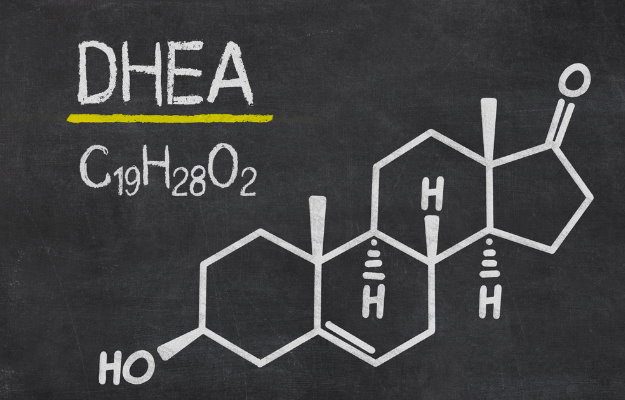
DHEA, dehydroepiandrosterone, comes mostly from your adrenal glands. It sits upstream of much of your hormonal system.
DHEA is a weak precursor. Your body converts it, tissue by tissue, into more active hormones like androgens and estrogens. That makes it less of a single actor and more of a raw material supply for energy, mood, libido, muscle, and bone.
Think of it as infrastructure. When the supply underneath the system is full, everything above it has more to draw on.
The quiet decade nobody names
DHEA often begins to decline in a woman’s thirties. The drop is slow, and it rarely announces itself.
You feel it as a thinning of resilience. Recovery from stress takes longer. A hard week costs more than it used to. Energy holds through the day with less to spare, and libido and motivation soften at the edges.
These changes accumulate over years with no single moment to point to. That is exactly why they get filed under stress or aging. The adrenal glands quietly produce less, and the effect shows up as shrinking margin rather than a broken number.
The slow and the cumulative are signal, not noise. When there is no acute symptom to chase, the drift itself is the finding.
Why your labs can read normal the whole time
Standard panels frequently leave DHEA-S off the order entirely. When it does appear, results get read against broad reference ranges built from population averages.
A number can sit inside a statistical range and still be low for you. Your working baseline is not the average of a crowd. I separate the two before I decide anything.
The loss shows up as reduced recovery capacity, not as a value that trips an alarm. A woman can stay inside every normal range for years while the supply underneath her system runs down.
Your lived experience is evidence here. A lab was never built to capture how much you have left at the end of the day.
Buying a product versus restoring a function
Over the counter DHEA and clinical DHEA are not the same practice. Commercial products vary in quality and dosing, which turns self supplementation into an uncontrolled experiment. Some women feel nothing. Others get side effects and never learn why.
In my practice I work differently, and I work with each patient directly.
- Baseline first — I measure DHEA-S before anything begins.
- Conservative dosing — I restore toward a physiological range, never toward a peak number.
- Ongoing monitoring — I track symptoms alongside downstream androgens and estrogens.
The goal is restoring a function that has thinned, calibrated to your labs, symptoms, and goals.
DHEA lives inside the whole system
DHEA never acts alone. Its conversion into androgens or estrogens varies from one woman to the next, so its effect always integrates into what is already in place.
I weigh the whole system before I add a part. If your estrogen, progesterone, and testosterone are already optimized, I ask how restoring the precursor reshapes them.
DHEA can support testosterone from the foundation up, sometimes reducing the need for direct testosterone. That is why I recheck the parts I thought were settled. The aim is a coherent hormonal signal, not another independent input stacked on top.
Adding a precursor without rechecking downstream levels risks quiet excess. Careful sequencing protects the balance you already built.
How I know DHEA is the missing piece
Three things line up when DHEA is the answer.
- A DHEA-S level that reads low or low normal for your age.
- A persistent pattern of thinned resilience despite optimized downstream hormones.
- A hormonal context where restoring the precursor helps the system rather than crowds it.
When the supply comes back into range, women describe a quiet return of margin. Stress clears faster. Energy holds in a way that feels sustainable. There is more internal reserve to lean on.
The phrase I hear most is feeling more solid, with more left at the end of the day. That is an additive gain in robustness, not a new effect layered on top of you.
What I want you to take from this
The slow erosion of resilience is not a fixed price of aging or stress. It can be a measurable shortage of the upstream material your hormonal system is built on.
Restoring that supply carefully gives back margin. You get more of yourself, calibrated to you, monitored over time, and grounded in your own numbers rather than a crowd’s average.
If you are already doing the foundational work and still feel diminished, DHEA is worth measuring before you accept the feeling as permanent.

Dr. Sue Piller
I’m Sue Piller, a Doctorally prepared Nurse Practitioner with advanced certifications in functional medicine, menopause, andropause mastery, and bioidentical hormone optimization.
I created AgeWell Hormone Health because I saw the same pattern every day in clinical practice — men and women doing “all the right things” yet still not feeling like themselves. Often, the missing piece was hormonal imbalance that hadn’t been fully evaluated or addressed.
After struggling to find safe, individualized hormone care for myself, I became determined to offer something better. My approach combines current hormone science with a lifestyle-forward, root-cause philosophy. I work directly with each patient using detailed lab testing, bioidentical hormones, and targeted peptides when appropriate — never a one-size-fits-all protocol.
My mission is simple:
To make excellent, individualized hormone care accessible and to help you feel like yourself again — with energy, clarity, confidence, and vitality at every stage of midlife and beyond.
My Philosophy:
Root-cause focused — I look deeper to understand why you feel the way you do.
Fully personalized — Every plan is built around your unique labs, symptoms, and goals.
Gentle and effective — I use bioidentical hormones in gentle transdermal organic bases for optimal absorption and excellent tolerability.
Whole-person… Read more