Hormone-related hair loss affects a substantial portion of women across their adult lives. It presents through androgenetic alopecia, postpartum telogen effluvium, and menopause-associated thinning.
Low-level laser therapy (LLLT) offers a non-invasive, medical-grade treatment for these conditions. The therapy holds FDA clearance for androgenetic alopecia in both male and female patients.
This article examines how LLLT works at the cellular level, which patients qualify for treatment, and how clinicians structure protocols for hormonally driven hair loss.
Hormonal Mechanisms in Female Hair Loss
Effective treatment begins with an accurate diagnosis. Female hair loss driven by hormones falls into several distinct clinical categories, and each carries its own mechanism.
Androgenetic Alopecia and DHT Sensitivity
Androgenetic alopecia in women follows a pattern of diffuse thinning across the crown. The underlying driver is follicular sensitivity to dihydrotestosterone (DHT), an androgen that binds to receptors in the dermal papilla and progressively miniaturizes the follicle.
Each growth cycle produces a shorter, finer hair. Untreated, the follicle eventually stops producing terminal hair altogether.
Estrogen Decline During Menopause
Estrogen extends the anagen, or growth, phase of the hair cycle. When estrogen levels fall during perimenopause and menopause, the protective effect on follicles weakens.
The relative influence of androgens increases, growth phases shorten, and shedding accelerates. Many women first notice diffuse thinning within a few years of their final menstrual period.
Postpartum Telogen Effluvium
Pregnancy elevates estrogen and holds a larger share of follicles in the growth phase. After delivery, hormone levels drop sharply and a large cohort of follicles shifts into the telogen, or resting, phase simultaneously.
The result is heavy shedding, typically beginning two to four months postpartum. This condition usually resolves, though recovery timelines vary and supportive treatment shortens the visible impact.
Thyroid Dysfunction as a Contributing Factor
Both hypothyroidism and hyperthyroidism disrupt follicular cycling and produce diffuse thinning. Thyroid assessment belongs in every diagnostic workup for female hair loss, because treating the gland disorder addresses the root cause. This step is commonly overlooked in routine evaluations.
How LLLT Works: Photobiomodulation at the Follicle Level
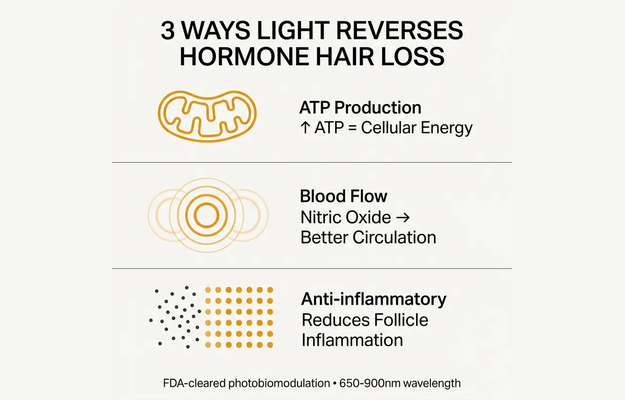
LLLT relies on photobiomodulation, the biological response of cells to specific wavelengths of light. Devices used for hair restoration emit light in the 650 to 900 nanometer range, which penetrates the scalp to reach the hair follicle.
At the cellular level, the light produces several documented effects.
First, it increases ATP production within the mitochondria of dermal papilla cells. Higher ATP output raises cellular metabolism and supports the energy-intensive process of hair fiber synthesis.
Second, the light stimulates nitric oxide release, which dilates local blood vessels and improves microcirculation to scalp tissue. Better perfusion delivers more oxygen and nutrients to follicles under hormonal stress.
Third, LLLT exerts anti-inflammatory effects on the follicular environment. Chronic low-grade inflammation contributes to follicular miniaturization in androgenetic alopecia, and reducing it supports the follicle’s return to a productive growth cycle.
These mechanisms explain why LLLT holds particular relevance for hormonal hair loss. The therapy addresses the downstream cellular consequences of DHT sensitivity and estrogen decline, meaning reduced follicular energy, restricted blood supply, and inflammation.
Clinical Evidence and Treatment Efficacy
LLLT devices carry FDA clearance for androgenetic alopecia in both women and men. This regulatory status distinguishes medical-grade photobiomodulation from cosmetic light products without clinical backing.
Clinical trials evaluating LLLT for pattern hair loss have measured increases in hair density and hair shaft diameter compared to sham devices. Diameter matters clinically because miniaturization, the progressive thinning of individual fibers, defines androgenetic alopecia.
Response patterns follow the etiology. Patients with hormonally driven pattern loss and active but miniaturized follicles respond well, because the therapy revives functioning follicles. Patients with scarring alopecia or fully dormant follicles show limited benefit, since LLLT stimulates existing follicular machinery.
Clinical note: visible improvement typically requires several months of consistent use. Clinicians should set this expectation at the first consultation, because early discontinuation is the most frequent cause of treatment failure.
LLLT also requires ongoing maintenance. Follicles under continued hormonal pressure return to their prior trajectory when treatment stops, so long-term protocols assume continued use at a reduced frequency.
Patient Selection and Diagnostic Assessment
Appropriate patient selection determines outcomes. The evaluation confirms a hormonal etiology and rules out conditions that require different treatment entirely.
Diagnostic Evaluation
The workup includes a clinical history covering onset, pattern, and hormonal events such as childbirth, menopause, or discontinuation of hormonal contraception. Scalp examination and trichoscopy identify miniaturization patterns consistent with androgenetic alopecia.
Laboratory assessment covers thyroid function, ferritin, vitamin D, and androgen levels where clinically indicated. These results either confirm the hormonal picture or reveal a treatable deficiency driving the shedding.
Ludwig Scale Classification
Clinicians grade female pattern hair loss on the Ludwig scale, which stages thinning from mild widening of the central part (Stage I) through pronounced crown thinning (Stage III). Earlier stages respond better to LLLT because more viable follicles remain.
Exclusion Criteria and Contraindications
LLLT is contraindicated in patients with active scalp malignancy or suspicious lesions in the treatment field. Patients taking photosensitizing medications require review before treatment. Scarring alopecias, active scalp infections, and inflammatory conditions such as lichen planopilaris require dermatologic management before any light-based therapy.
Unexplained rapid hair loss warrants a full medical workup before device treatment. Photobiomodulation must never substitute for diagnosis of an underlying endocrine or autoimmune disorder.
Treatment Protocols and Device Selection
Device quality and protocol adherence drive results. Clinicians distinguish between medical-grade laser diode systems and consumer LED products, with wavelength output, energy density, and scalp coverage as the deciding specifications.
In-office protocols typically schedule sessions two to three times per week, with each session lasting roughly twenty to thirty minutes depending on the device. The supervised setting ensures correct dosing and allows the clinician to monitor scalp response and photograph progress.
Home-use devices, including laser caps and helmets, extend treatment between office visits or serve as the primary modality for patients who cannot attend frequent appointments. Compliance becomes the central variable in home protocols. The clinician should establish a fixed schedule, document baseline photographs, and review adherence at follow-up visits.
For patients on hormone replacement therapy, LLLT integrates without interaction concerns. The two approaches work on separate levels. Hormone therapy addresses the systemic environment while photobiomodulation supports the follicle directly.
Adjunctive Therapies and Comprehensive Treatment Plans
LLLT performs best within a comprehensive plan rather than as a standalone intervention. Hormone-related hair loss is multifactorial, and layered treatment addresses more of the contributing mechanisms.
Topical minoxidil combines readily with LLLT, and the pairing targets both blood flow and growth-phase extension. Platelet-rich plasma (PRP) injections add growth factor stimulation at the follicle and fit into the same treatment calendar. For patients with confirmed androgen excess, hormone modulation under physician supervision addresses the systemic driver while LLLT supports follicular recovery.
Nutritional support belongs in every plan. Correcting ferritin, vitamin D, and zinc deficiencies removes obstacles to follicular function that light therapy alone cannot overcome.
Stress management carries clinical weight as well. Elevated cortisol pushes follicles into the resting phase and compounds hormonally driven shedding, so addressing chronic stress supports every other component of the protocol.
Long-term maintenance completes the plan. After the initial treatment phase, clinicians taper session frequency to a maintenance schedule and reassess at defined intervals with standardized photography and density measurement.
Clinical Summary
LLLT functions as an evidence-based adjunctive therapy for hormone-related hair loss in women. Its FDA clearance, documented cellular mechanisms, and favorable safety profile support its place in modern hair restoration practice.
Three principles govern successful application. Diagnosis must confirm a hormonal etiology and exclude contraindications before treatment begins. Protocols must specify wavelength, session frequency, and duration, with compliance monitored throughout. Integration with hormonal, topical, and nutritional therapies produces the strongest clinical outcomes.
Women experiencing pattern thinning, postpartum shedding, or menopause-associated hair loss should seek evaluation from a qualified provider. A structured diagnostic workup determines whether photobiomodulation belongs in the treatment plan and establishes the baseline against which progress will be measured.

Kimberly Pryslak, NP
With more than 25 years of clinical experience, Kimberly Pryslak, NP, brings a rare combination of medical insight, trichology expertise, and empathetic care to every patient she sees. Since joining Medi Tresse in 2018, she has become a trusted leader in female hair loss, both as a provider and a passionate advocate for women’s health.
Kimberly is a board-certified Nurse Practitioner who has trained extensively under Dr. Mark DiStefano and Dr. Mary Wendel, gaining a deep understanding of the complex causes of female hair loss. While her clinical knowledge runs deep, patients praise her for her compassion and ability to listen. Kimberly’s approach is expansive and precise, treating hair loss as a symptom that deserves a full-body understanding.
(Education and Credentials)
Bachelor of Science in Nursing – Catholic University
Master of Science in Nursing – Columbia University
Board-Certified Nurse Practitioner
(Clinical Focus Areas)
Female Hair Loss Diagnosis & Treatment
Trichology-Based Hair Restoration
Hormonal Imbalance & Menopause-Related Hair Loss
Holistic and Personalized Care Models
(Certifications and Special Training)
USTI Hair Loss Practitioner – U.S. Trichology Institute
Certificate of Associate Trichology Diploma – World Trichology Society
Blood Testing for Trichology – World Trichology Society
… Read more