You wake up twice a night to use the bathroom. You scan for restrooms before every errand. You laugh, sneeze, or lift something heavy and feel a leak.
Then your doctor tells you this is normal aging.
It deserves a closer look. Bladder changes at midlife have a specific, identifiable driver in most women. That driver is declining estrogen, and it is commonly overlooked in standard care.
The Real Reason Your Bladder Changed After 40
Here’s what happens inside your body. Your bladder, urethra, and pelvic floor tissues are lined with estrogen receptors. These tissues depend on estrogen to stay strong, elastic, and well coordinated.
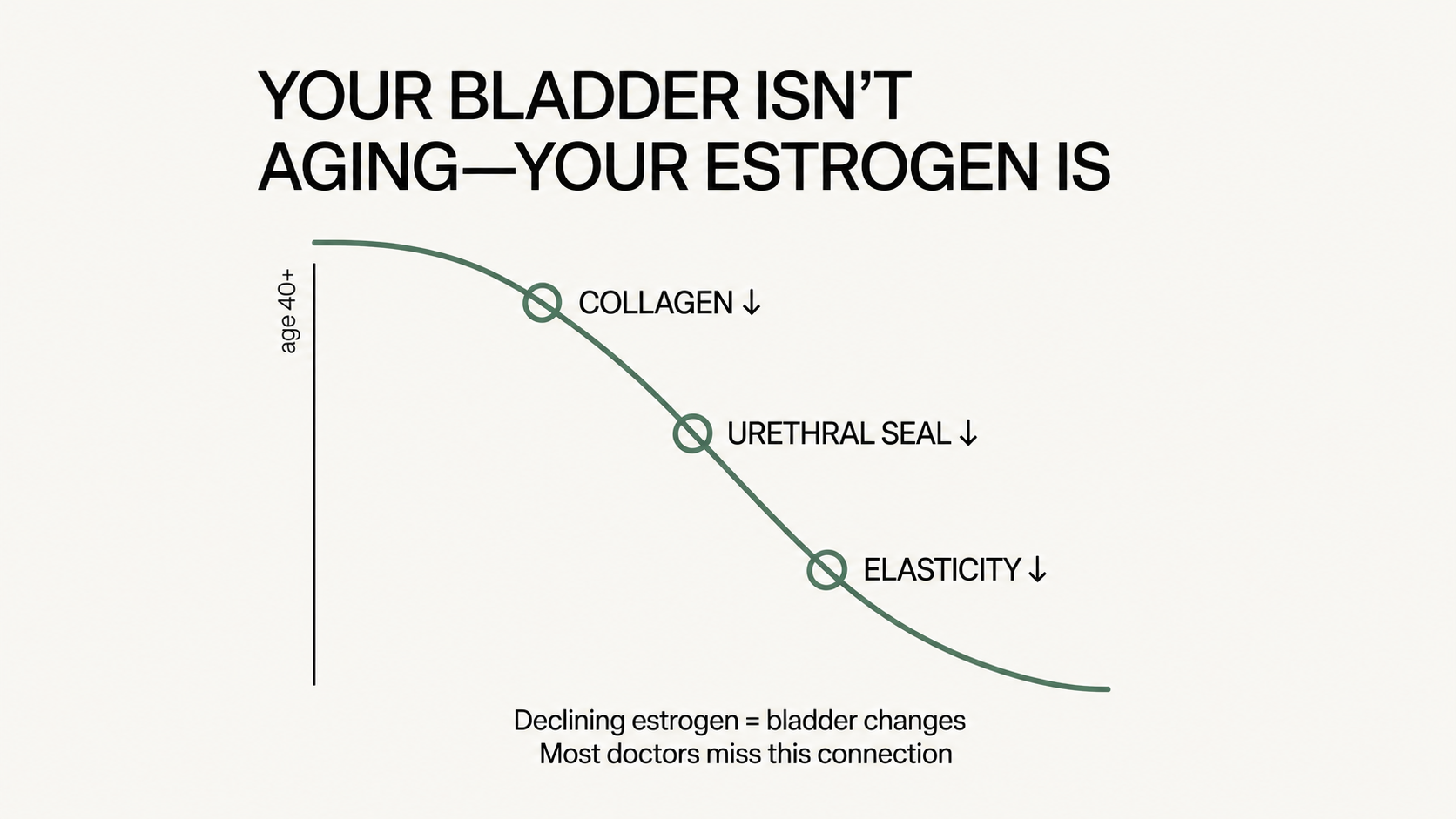
When estrogen declines during perimenopause and menopause, several things shift at once:
- Collagen production drops, weakening the structural support around your bladder
- The urethral lining thins, reducing the seal that keeps urine in
- Tissue elasticity fades, so your bladder signals urgency earlier and louder
The result shows up as urgency, frequency, nighttime waking, and stress incontinence. These are symptoms of hormone decline, and hormone decline is something you can address.
What Conventional Medicine Misses About Bladder Health
Standard care typically offers three things: Kegel exercises, bladder training, or anticholinergic medications.
Each has a place. Each also has a limit.
Medications quiet the symptoms while the underlying tissue keeps weakening. They also carry side effects that matter, including dry mouth, constipation, and cognitive effects in some women.
Pelvic floor therapy strengthens muscles, and that helps. Strengthening a muscle does little for tissue that has lost its collagen and blood supply from hormone loss. You end up doing everything right and still leaking.
Strengthening exercises work best on tissue that has the hormonal support to respond. When estrogen is depleted, you are training tissue that lacks its building materials.
Functional medicine looks at the big picture, not just the symptom. We examine how your hormones, inflammation levels, blood sugar, and gut health interact, because your bladder is deeply connected to your overall systemic health.
How Estradiol, your body’s most potent form of Estrogen, Supports Bladder Function
Estradiol supports your urinary function in four specific ways:
- Maintains collagen and elasticity in bladder and urethral tissue
- Supports a healthy vaginal microbiome, which protects you from the recurrent UTIs that inflame and irritate the bladder
- Regulates bladder muscle tone and the coordination between bladder contractions and sphincter control
- Keeps local tissue nourished with adequate blood flow
Worth knowing: Local vaginal hormone creams that may include Estradiol, DHEA and/or Testosterone restore tissue integrity directly at the source. This applies even when your systemic hormone levels look balanced on paper. The tissue itself needs local support.
The Functional Medicine Approach to Bladder Dysfunction
A root-cause workup starts with comprehensive hormone testing. That means assessing Estradiol, Progesterone, Testosterone and DHEA, since all of these influence pelvic tissue health.
From there, the plan gets personal:
- Bioidentical hormone replacement therapy (BHRT) when appropriate, to restore the tissue-level support your bladder lost
- Inflammation assessment, because chronic inflammation irritates the bladder lining
- Blood glucose and insulin evaluation, since glucose imbalances and insulin resistance increase urinary frequency and feed harmful bacteria
- Gut health review, because gut dysbiosis affects your urinary microbiome
- Lifestyle recommendations, that consider caffeine intake, fluid timing, stress response, and pelvic floor function
This is the difference between managing a symptom and optimizing a bodily function.
Beyond Hormones: Supporting Bladder Health from the Root
Hormone balance sets the foundation. These strategies build on it:
Calm the inflammation. An anti-inflammatory diet with omega-3 support reduces the background irritation that amplifies urgency.
Feed the right microbes. Targeted probiotics and reduced sugar intake support the vaginal and urinary microbiome that protects your bladder.
Rebuild the tissue. Adequate protein, vitamin C, and collagen-building nutrients give your body the raw materials for repair.
Manage your stress load. Cortisol patterns directly influence bladder sensitivity. A nervous system stuck in overdrive keeps your bladder on high alert too.
What You Can Do Right Now
Take bladder changes seriously if they disrupt your sleep or your life. Disrupted sleep alone drives weight gain, mood changes, and hormone imbalance, creating a cycle that worsens everything.
Start here:
- Track your patterns for two weeks. Write down when urgency hits, what you drank beforehand, and how often you wake at night.
- Question the “it’s normal” answer. Common or average and normal are very different things. You deserve an investigation and a full explanation.
- Find a provider who tests before treating. Look for someone who evaluates hormones, inflammation, and metabolic health as a connected picture.
Your bladder changed for a reason. When you address that reason at its root, comfort, confidence, and full nights of sleep come back within reach.
You have options beyond pads, pills, and Kegels. Restoring hormone balance restores function, and that restores your life.

Donna Figueroa, CNM, FMACP, MSN, APRN
Donna is passionate about guiding women through midlife transformation. She is a Certified Functional Medicine Provider, Licensed Nurse Practitioner, and Board-Certified Nurse Midwife who has spent the last 15 years caring for women across the lifespan and solving medical mysteries for many who have otherwise been unable to find resolution elsewhere.
In 2015 Donna found herself in the throes of perimenopause, 40 pounds overweight with excruciating joint pain, 2 failing hips, a dependence on NSAIDs, thinning hair, weak nails, and hot flashes galore. Her physical therapist told her she needed double hip replacement surgery. Instead of going under the knife and falling prey to worsening menopausal symptoms, Donna researched alternatives and discovered the wonders of Functional Medicine!
Within weeks, her pain resolved; Donna avoided surgery, discontinued taking NSAIDs, and lost 40 pounds by addressing the root cause of her chronic inflammation, changing her lifestyle, altering her diet, and reducing toxic exposures.
Donna even turned back her biological clock, which currently registers at 14 years younger than her chronological age.
Donna’s health transformation fueled her enthusiasm and desire to help others achieve the same success, and she is committed to providing guidance and support to anyone who is determined to do… Read more