I hear the same phrase in my practice almost daily.
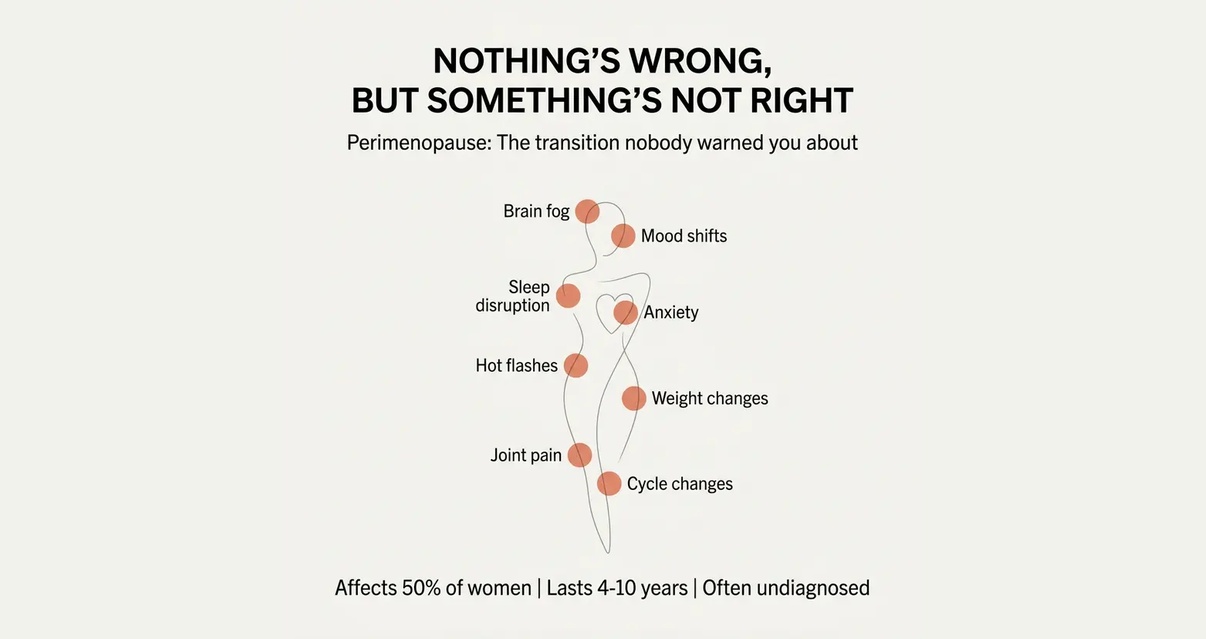
“Nothing’s wrong, but something’s not right.”
You’re tired in a way that sleep doesn’t fix. Your brain feels foggy when you used to be sharp. Your body responds differently to the same foods, the same workouts, the same sleep schedule. You go to your doctor, run the tests, and everything comes back normal.
But you know something has shifted.
Welcome to perimenopause. The transition your body enters years before menopause actually arrives, and the one most of us were never taught to recognize.
The Gap Between What You Feel and What Medicine Sees
Here’s what happens in most medical appointments: You describe your symptoms. Your doctor orders bloodwork. The results show you’re “within normal range.” You leave feeling dismissed, confused, or wondering if you’re imagining things.
You’re not.
The problem is that our healthcare system is built to identify disease, not transition. We’re trained to look for pathology, for clear markers of illness. Perimenopause doesn’t show up that way.
Your hormones are fluctuating wildly, sometimes hour by hour. A single blood test captures one moment in time. It’s like trying to understand the ocean by looking at a single wave.
I’ve spent years on the frontlines of women’s health, and I’ve seen this gap between experience and diagnosis create real suffering. Women in their late 30s and 40s who feel like they’re losing themselves, who wonder if they’re developing early dementia or chronic fatigue, when what they’re actually experiencing is a normal biological transition that nobody prepared them for.
What Perimenopause Actually Looks Like
Perimenopause typically begins in your 40s, though it can start in your late 30s. It lasts an average of four years, but for some women, it stretches to ten.
During this time, your ovaries gradually produce less estrogen. But the decline isn’t linear. It’s erratic.
One month your estrogen might spike higher than it’s been in years. The next month it plummets. Your body is trying to adjust to a new normal, and the adjustment period is messy.
The symptoms show up in ways you might not connect to hormones:
- Sleep disruption that has nothing to do with stress or caffeine
- Weight gain around your midsection despite no changes to diet or exercise
- Brain fog that makes you forget words mid-sentence
- Mood swings that feel disproportionate to what’s happening in your life
- Joint pain that appears out of nowhere
- Changes in your menstrual cycle, from heavier bleeding to skipped periods
- Hot flashes that wake you at night drenched in sweat
- Anxiety that wasn’t there before
You might experience all of these. You might experience three. The variability is part of what makes perimenopause so hard to pin down.
Why We Don’t Talk About This
I’ve watched brilliant, accomplished women apologize for bringing up their symptoms. They minimize what they’re experiencing. They say things like “I know it’s probably nothing” or “I don’t want to waste your time.”
This tells me we’ve failed at basic health education.
Perimenopause affects roughly half the population. It’s not a rare condition. It’s not a niche experience. Yet most women enter it completely unprepared.
Part of the problem is cultural. We don’t have comfortable, open conversations about women’s hormonal health. Menstruation is whispered about. Menopause is treated as the punchline to a joke about hot flashes. The years-long transition between the two barely gets mentioned.
Part of the problem is medical. Traditional medical education spends minimal time on perimenopause. Doctors learn about menopause as a defined endpoint, but the transition leading up to it gets glossed over.
The result is a knowledge gap that leaves millions of women struggling in silence.
The Real Impact on Your Life
The symptoms of perimenopause aren’t just uncomfortable. They affect your ability to function at work, show up in your relationships, and feel like yourself.
I’ve had patients describe it as feeling like they’re watching their life through a fog. The sharpness is gone. The energy that used to carry them through demanding days has evaporated.
Sleep disruption alone can derail everything else. When you’re not sleeping, your mood regulation suffers. Your cognitive function declines. Your patience wears thin. You reach for sugar and caffeine to compensate, which can worsen hormonal fluctuations.
The weight gain, particularly around the midsection, isn’t vanity. It’s a shift in how your body stores fat, driven by changing estrogen levels. This type of fat storage is associated with increased health risks, including cardiovascular disease and metabolic syndrome.
The brain fog is real and measurable. Estrogen plays a role in cognitive function, memory, and verbal fluency. When it fluctuates, you notice the difference.
These aren’t minor inconveniences. They’re significant quality-of-life issues that deserve attention and treatment.
What You Can Do About It
The good news is that you have options. Understanding what’s happening in your body is the first step. From there, you can make informed decisions about how to manage your symptoms.
Lifestyle modifications matter more than you might think.
Regular exercise, particularly strength training, helps maintain muscle mass and bone density as estrogen declines. It also supports better sleep and mood regulation.
Nutrition shifts can make a real difference. Reducing alcohol and caffeine often helps with sleep and hot flashes. Increasing protein supports muscle maintenance. Adding phytoestrogens from foods like flax seeds and soy can provide mild estrogenic effects.
Stress management isn’t optional during this transition. High cortisol levels can worsen perimenopausal symptoms. Finding ways to regulate your nervous system—whether through meditation, yoga, therapy, or simply regular breaks—supports your hormonal balance.
Medical interventions are also available.
Hormone replacement therapy can be life-changing for some women. Low-dose birth control pills can help regulate erratic cycles and provide symptom relief. Non-hormonal medications can address specific symptoms like hot flashes or mood changes.
The key is finding a healthcare provider who takes your symptoms seriously and is willing to work with you to find solutions. If your current doctor dismisses your concerns, find someone else. You deserve care that acknowledges your experience.
Reframing the Conversation
I want to shift how we think about perimenopause.
This isn’t a disease state. It’s a transition. Your body is moving from one phase of life to another, and transitions are inherently unstable.
But unstable doesn’t mean unmanageable.
When you understand what’s happening, you can respond strategically instead of reactively. You can advocate for yourself in medical settings. You can make lifestyle choices that support your changing physiology. You can find community with other women going through the same experience.
You can stop wondering if something is wrong with you and start recognizing this as a normal, navigable phase of life.
The transition might not have come with a warning label, but you don’t have to go through it alone or uninformed.
I’ve spent my career working to close the gap between what women experience and what medicine acknowledges. I’ve seen what happens when women get the information and support they need. They reclaim their energy. They feel like themselves again. They move through this transition with confidence instead of confusion.
That’s what I want for you.
Moving Forward
If you’re reading this and recognizing yourself in these descriptions, start by tracking your symptoms. Note patterns in your sleep, mood, cycle, and energy levels. This information helps when you talk to your healthcare provider.
Educate yourself. The more you understand about what’s happening in your body, the better equipped you are to make decisions about your care.
Find your people. Talk to friends who might be going through this. Join communities where women share their experiences. You’ll quickly realize how common your symptoms are.
And most importantly, trust yourself. If something feels off, it probably is. You know your body better than anyone else.
Perimenopause is the transition nobody warned you about, but it doesn’t have to be the transition you suffer through in silence.
You have options. You have support available. And you have every right to feel good in your body during this phase of life.
The warning might have come late, but the information is here now. What you do with it is up to you.

Antje Dangel, PA-C
Antje Dangel, PA-C, is the Co-Founder, Clinical Director, and Master Injector at Eternal MedSpa in Sarasota and Venice, Florida. Originally from Berlin, Germany, she is a nationally board-certified Physician Assistant-Certified and a Florida-licensed medical provider whose clinical foundation reaches well beyond aesthetics. Her background spans women’s health, emergency medicine, high-acuity nursing, and academic medicine, including a role as a Clinical Assistant Professor at the Florida State University College of Medicine. She holds degrees in nursing from the University of South Florida and in Physician Assistant Studies from Barry University.
That women’s health foundation is part of what makes Antje especially well suited to guests navigating perimenopause, menopause, and the broader changes of healthy aging. She understands that the hormonal shifts of midlife affect far more than skin. They influence body composition, metabolic health, energy, and confidence, and she approaches each guest with that full picture in mind rather than treating a single concern in isolation.
As Clinical Director, Antje sets the clinical standards for Eternal MedSpa. She shapes the practice’s consultation process, safety protocols, provider expectations, and its natural-looking aesthetic philosophy. She is known for precise wrinkle-relaxer treatments, thoughtful dermal filler planning, facial balancing, PRP, wellness injections, IV therapy, and… Read more