
I remember the day a patient walked into my office with a stack of hormone test results, convinced they held all the answers to her perimenopausal symptoms.
She’d paid hundreds of dollars out of pocket. She’d waited weeks for results. And now she sat across from me, frustrated and confused, because the numbers didn’t match how terrible she felt.
This happens more often than you’d think.
Women come to me expecting hormone tests to be the golden key that unlocks their diagnosis. They want concrete numbers. They want validation. They want proof that what they’re experiencing is real.
I get it. After my own journey through perimenopause—the dizzy spells, heart palpitations, panic attacks, severe mood swings, and that frustrating 40-pound weight gain—I wanted answers too.
But here’s what I’ve learned in my years of practice, and what major medical organizations like ACOG (American College of Obstetricians and Gynecologists) and NICE (National Institute for Health and Care Excellence) have established through clinical consensus:
Hormone testing can help. But it’s not the definitive answer most women hope it will be.
The Reality of Hormone Testing in Perimenopause
Your hormones during perimenopause are like a rollercoaster that’s constantly changing its track.
One day your estrogen is high. The next week it’s low. Two weeks later it’s somewhere in between. This fluctuation is the hallmark of perimenopause, and it’s exactly what makes testing so tricky.
When you test hormones during perimenopause, you’re getting a snapshot of one moment in time. It’s like trying to understand an entire movie by looking at a single frame.
That snapshot might show normal levels even when you’re experiencing severe symptoms.
Or it might show abnormal levels on a day when you actually feel fine.
This is why ACOG and NICE both emphasize that clinical diagnosis based on symptoms and age is often more reliable than hormone testing alone during the perimenopausal transition.
When Hormone Tests Actually Make Sense
I don’t want you to think hormone testing is useless. It has its place.
Here’s when I typically recommend testing:
When you’re under 45 and experiencing menopausal symptoms. We need to rule out premature ovarian insufficiency or other conditions that might be causing your symptoms.
When your symptom picture is unclear. If you have symptoms that could be thyroid-related, adrenal-related, or hormonal, testing helps us narrow down the source.
When we’re considering or monitoring hormone therapy. Baseline testing and follow-up labs can help us tailor your treatment and ensure you’re responding appropriately.
When you’ve had a hysterectomy. Without periods to track, testing becomes more valuable in determining where you are in the menopausal transition.
When symptoms persist despite treatment. If you’re on bioidentical hormone replacement therapy (BHRT) and still struggling, testing helps us adjust your protocol.
The Tests That Actually Matter
Not all hormone tests are created equal.
When I do recommend testing, here’s what I typically look at:
FSH (Follicle-Stimulating Hormone)
This is the test most doctors use to assess menopausal status. As your ovaries produce less estrogen, your pituitary gland produces more FSH to try to stimulate them.
An elevated FSH can suggest you’re in perimenopause or menopause. But remember that fluctuation issue? Your FSH can be high one week and normal the next during perimenopause.
Estradiol
This is your main form of estrogen. Low levels can correlate with menopausal symptoms, but again, levels fluctuate wildly during perimenopause.
I find estradiol testing most useful when we’re monitoring hormone therapy, not for initial diagnosis.
Thyroid Panel (TSH, Free T3, Free T4)
This isn’t technically a sex hormone test, but it’s critical. Many perimenopausal symptoms overlap with thyroid dysfunction.
After my emergency c-section, my autoimmune thyroiditis was missed by multiple doctors. My symptoms—exhaustion, hair loss, weight gain—looked like postpartum issues but were actually thyroid-related.
I never evaluate a woman’s hormonal health without checking her thyroid.
Progesterone
During perimenopause, progesterone often drops before estrogen does. This creates estrogen dominance, which can cause heavy periods, mood swings, and sleep problems.
Testing progesterone can be helpful, but timing matters. If you’re still having periods, we need to test at the right point in your cycle (typically day 21 of a 28-day cycle).
Testosterone and DHEA
These androgens decline with age and can affect energy, libido, muscle mass, and mood.
I often test these when women complain of severe fatigue, loss of motivation, or diminished sex drive that doesn’t improve with estrogen and progesterone support alone.
What Matters More Than the Numbers
Here’s what I tell every patient who comes to me wanting hormone tests:
Your symptoms tell me more than any lab result ever will.
When Dr. Serena ran my labs and showed me my hormone dysregulation, the numbers confirmed what my body had been screaming for months. But she didn’t need those numbers to know I needed help.
The clinical consensus from ACOG and NICE supports this approach. They recommend that for most women over 45 with typical menopausal symptoms, diagnosis can be made clinically without hormone testing.
This doesn’t mean your symptoms aren’t real or don’t deserve treatment. It means your experience matters more than a number on a page.
The Questions I Ask Instead
When a patient comes to me with perimenopausal concerns, I focus on these areas:
Menstrual pattern changes: Are your periods irregular, heavier, lighter, or closer together?
Vasomotor symptoms: Are you experiencing hot flashes, night sweats, or temperature regulation issues?
Sleep quality: Are you having trouble falling asleep, staying asleep, or waking unrefreshed?
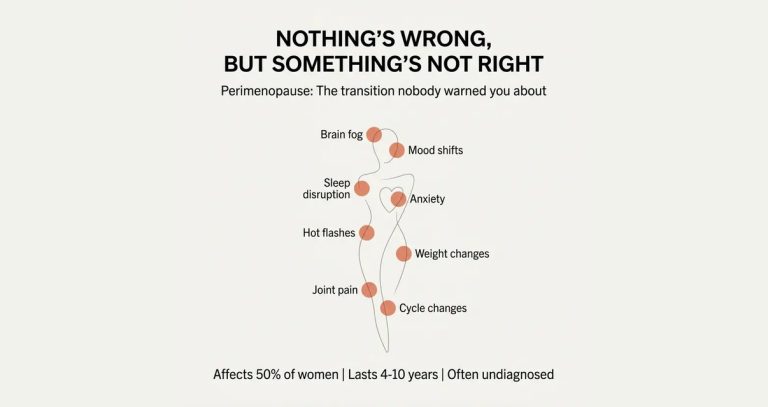
Mood changes: Are you experiencing anxiety, depression, irritability, or mood swings that feel different from your baseline?
Cognitive function: Are you noticing brain fog, memory issues, or difficulty concentrating?
Physical symptoms: Are you experiencing joint pain, muscle aches, heart palpitations, or dizziness?
Sexual health: Are you noticing changes in libido, vaginal dryness, or pain with intercourse?
Body composition: Are you experiencing unexplained weight gain, particularly around your midsection?
These questions paint a picture that no hormone panel can fully capture.
The Testing Trap I See Too Often
The wellness industry has created a testing obsession.
Companies market at-home hormone tests promising to reveal exactly what’s wrong with you. They charge hundreds of dollars for panels that test everything under the sun.
Then you get results with little context, no medical interpretation, and often recommendations for expensive supplements or treatments you may not need.
I’ve seen women spend thousands of dollars on testing and supplements based on minor lab variations that fall within normal ranges.
I’ve also seen women ignore significant symptoms because their tests came back “normal.”
This is the danger of putting too much faith in numbers alone.
When Testing Becomes Harmful
Excessive or poorly timed hormone testing can actually delay proper treatment.
I’ve had patients who spent months getting test after test, trying different supplements based on results, while their quality of life continued to decline.
One woman came to me after a year of this cycle. Her original symptoms—hot flashes, mood swings, and sleep disruption—had worsened significantly. She’d spent over $3,000 on testing and supplements.
Within weeks of starting appropriate bioidentical hormone replacement therapy based on her clinical presentation, she felt dramatically better.
The tests hadn’t helped her. They’d distracted from what she actually needed.
What About Testing While on Hormone Therapy?
This is where testing becomes more valuable.
When I start a patient on BHRT, I typically recheck levels after 6-8 weeks to ensure we’re in the right range and that you’re responding well.
But even here, I prioritize how you feel over what the numbers say.
If your estradiol level looks perfect on paper but you’re still having hot flashes, we adjust. If your progesterone is in range but you’re not sleeping well, we modify the protocol.
The goal isn’t perfect numbers. The goal is you feeling like yourself again.
The Tests You Shouldn’t Skip
While hormone testing has limitations, there are other tests I consider essential during this transition:
Comprehensive metabolic panel: Checks kidney and liver function, blood sugar, and electrolytes.
Lipid panel: Estrogen loss affects cholesterol levels and cardiovascular risk.
Vitamin D: Deficiency is common and affects bone health, mood, and immune function.
Complete blood count: Rules out anemia, which can cause fatigue and other symptoms that mimic hormonal issues.
Hemoglobin A1C: Screens for insulin resistance and diabetes risk, which increases during menopause.
These tests give me a complete picture of your health, not just your hormones.
My Approach to Testing
After years of practice and my own personal experience, here’s how I approach hormone testing:
I listen first. Your story tells me more than any lab result.
I test strategically. I order tests that will actually change my treatment approach, not just satisfy curiosity.
I interpret results in context. A number means nothing without considering your symptoms, age, health history, and goals.
I treat the person, not the lab result. If you feel terrible but your tests are “normal,” we still address your symptoms.
I educate thoroughly. I want you to understand what we’re testing, why we’re testing it, and what the results mean for your specific situation.
What You Should Know Before Ordering Tests
If you’re considering hormone testing, ask yourself these questions first:
Will this test change my treatment plan? If you’re already experiencing clear menopausal symptoms and are a candidate for hormone therapy, testing may not add value.
Am I testing at the right time? For cycling women, timing matters. Random testing can give misleading results.
Who will interpret these results? Make sure you’re working with a provider who understands the limitations and nuances of hormone testing.
Can I afford this? Many hormone tests aren’t covered by insurance. Make sure the cost is worth the potential information gained.
Am I testing to validate my experience? You don’t need a lab result to prove your symptoms are real. They are real because you’re experiencing them.
The Bottom Line on Hormone Testing
Hormone testing can be a useful tool when used appropriately and interpreted correctly.
But it’s not the answer to every question, and it’s certainly not required for every woman going through perimenopause or menopause.
The clinical consensus from major medical organizations supports a symptom-based approach for most women. Your experience, your age, and your symptom pattern often tell us everything we need to know to help you.
Testing should support clinical decision-making, not replace it.
If you’re struggling with symptoms, don’t wait for the perfect test result to seek help. Your symptoms deserve attention and treatment regardless of what any lab report says.
After I started BHRT under Dr. Serena’s care, I regained my life. Not because the tests showed the perfect numbers, but because we addressed what my body was telling us.
That’s the approach I take with every patient. And that’s the approach I encourage you to expect from your healthcare provider.
You deserve care that sees you as a whole person, not just a collection of lab values.
Moving Forward
If you’re navigating perimenopause or menopause and wondering whether hormone testing is right for you, start with a comprehensive conversation with a provider who specializes in women’s hormonal health.
Discuss your symptoms in detail. Talk about your goals for treatment. Ask what testing would actually change about your care plan.
And remember that whether or not you pursue testing, your symptoms are valid, your experience matters, and effective treatment options exist.
You don’t need permission from a lab result to feel better.
You just need the right support, the right approach, and a provider who listens to what your body is telling you.
Because at the end of the day, that’s what makes the difference between struggling through this transition and thriving through it.

Antje Dangel, PA-C
Antje Dangel, PA-C, is the Co-Founder, Clinical Director, and Master Injector at Eternal MedSpa in Sarasota and Venice, Florida. Originally from Berlin, Germany, she is a nationally board-certified Physician Assistant-Certified and a Florida-licensed medical provider whose clinical foundation reaches well beyond aesthetics. Her background spans women’s health, emergency medicine, high-acuity nursing, and academic medicine, including a role as a Clinical Assistant Professor at the Florida State University College of Medicine. She holds degrees in nursing from the University of South Florida and in Physician Assistant Studies from Barry University.
That women’s health foundation is part of what makes Antje especially well suited to guests navigating perimenopause, menopause, and the broader changes of healthy aging. She understands that the hormonal shifts of midlife affect far more than skin. They influence body composition, metabolic health, energy, and confidence, and she approaches each guest with that full picture in mind rather than treating a single concern in isolation.
As Clinical Director, Antje sets the clinical standards for Eternal MedSpa. She shapes the practice’s consultation process, safety protocols, provider expectations, and its natural-looking aesthetic philosophy. She is known for precise wrinkle-relaxer treatments, thoughtful dermal filler planning, facial balancing, PRP, wellness injections, IV therapy, and… Read more